Niacin: What You Need to Know About This Top Vitamin for Increasing Good Cholesterol & Fighting Heart Disease
© 2013 Health Realizations, Inc.
Niacin, also known as vitamin B3, is one nutrient that you don't hear much about, but that is working silently behind the scenes in some very powerful ways. And, like vitamin C, niacin is a water-soluble vitamin, which means that your body excretes it in your urine -- and needs a continuous supply to stay healthy.
|

If you like mushrooms, you're in luck! Crimini mushrooms are one of the best sources of niacin out there (and eating them raw maximizes the vitamins).
|
What is So Good About Niacin?
Niacin's role in your body is to help your digestive system, skin and nerves to function. Meanwhile, niacin helps you to convert food into that thing that most of us can't seem to get enough of ... energy.
Niacin also helps your body to process fats, produce DNA (niacin deficiency can even cause DNA damage), and regulate blood sugar and insulin metabolism.
Health Benefits of Niacin: From Cholesterol to Insomnia
Niacin has such a large-scale impact on the body that it's been linked to preventing or treating over 20 serious illnesses, such as:
-
Cataracts
-
Depression
-
Multiple Sclerosis
-
Insomnia
-
Rheumatoid Arthritis
-
Diabetes
-
Headaches
- Inflammatory Bowel Disease
Further, niacin is well known to help lower cholesterol, and is particularly useful for helping to "increase good (HDL) cholesterol" * and decrease triglycerides (a form of fat in your bloodstream). Several studies have even found that niacin can increase HDL by 30 percent while lowering total cholesterol by 10 percent to 25 percent.
But that's not all. Because niacin can help lower high cholesterol and fat levels in the blood, it may also be useful in preventing heart disease.
And, according to a study in the August 2004 issue of the Journal of Neurology, Neurosurgery and Psychiatry, eating foods rich in niacin can help protect against Alzheimer's disease and age-related cognitive decline.
What Foods are Rich in Niacin?
As with all vitamins, the best way to get enough niacin in your body is by eating whole foods. It's worth noting, though, that some of the reported benefits (like lowering cholesterol) have been achieved through prescription-strength niacin (not the type available over the counter).
Taking these types of niacin mega-doses should only be done with the supervision of your health care provider, as there can be side effects, including flushing, hot flashes, peptic ulcers, skin rashes and liver damage.
Getting niacin from whole foods is also an excellent way to ensure that you're getting just a good amount (the RDA is 16 mg/day for men, and 14 mg/day for women). A variety of foods are rich in this powerful vitamin, including:
Be sure to also check out Alive in 5: Raw Gourmet Meals in Five Minutes. This incredibly unique and highly recommended cookbook has quick and easy recipes for stuffed mushrooms, salads, and veggie dishes -- all made from raw, healthy ingredients. Best of all, the recipes can be made in a snap, so you, and your family, can eat healthy every night of the week!
* High Cholesterol? The Following are 12 TOP Non-Drug Strategies to Increase Your HDL Levels
Think you've heard it all when it comes to cholesterol? Well, even the most cholesterol-savvy among us may be in for a surprise ... it turns out that perhaps the most important aspect has to do with making sure you have enough of it -- the good kind, that is.
Cholesterol, of course, is composed of two types: the good "HDL" (high-density lipoprotein) cholesterol and the bad "LDL" (low-density lipoprotein) variety.
Most Americans focus on reducing LDL cholesterol as a key part of their treatment regimen. However, a new study found that having too little good cholesterol is at least as damaging when it comes to heart disease as having too much of the bad kind, and it may even be more damaging.
"The public was first educated on total cholesterol, and then the shift was on LDL cholesterol and keeping that level down," said Dr. Christie Ballantyne, a professor of medicine at Baylor College of Medicine. "HDL cholesterol is at least as important as LDL cholesterol and may even be more predictive of heart disease."
|
.aspx?width=222&height=148)
Increasing your HDL: Another benefit of exercise.
|
In fact, in people with heart disease, the most common cholesterol problem is too little HDL. That's because HDL cholesterol works to remove LDL cholesterol from the arteries. "Even if their total cholesterol and LDL cholesterol levels are normal, people with reduced levels of HDL have an increased risk of early coronary artery disease," says Richard N. Fogoros, M.D.
When HDL levels are increased, a little goes a long way. It's estimated that for every 1 mg/dl increase in HDL cholesterol, there is a 2 percent to 4 percent decrease in your risk of coronary heart disease.
12 Strategies to Increase Your HDL
If your HDL levels are lacking, here are some key ways to boost them.
Exercise: Aerobic exercise, the kind that raises your heart rate for an extended period of time (say 20 or 30 minutes), can increase your HDL if done regularly. Examples include jogging, biking, fast walking, aerobics, etc.
Maintain a healthy weight: Being overweight or obese can increase your LDL cholesterol levels while reducing your HDL. Losing weight can help to increase HDL.
|
.aspx?width=222&height=143)
Doughnuts, along with other foods that contain trans fats, are some of the worst foods you could eat: they lower your good cholesterol and increase the bad.
|
Don't eat trans fats: Trans fats are an unhealthy type of fat found in margarine, shortening, fried foods like french fries and fried chicken, doughnuts, cookies, pastries and crackers. Anything that contains hydrogenated or partially hydrogenated oil also contains them.
These artery-clogging fats are known to increase LDL cholesterol and decrease HDL. Avoiding foods that contain them (you have to be diligent in reading labels to do so, as many processed products contain them) can help to raise your HDL levels significantly.
Eat more monounsaturated fats: Increasing foods that contain these healthy fats -- olive oil, peanut butter, avocados, etc. -- can raise your HDL levels without harming your total cholesterol.
Eat soluble fiber: Fiber can increase your HDL cholesterol while decreasing the LDL. It's found in fruits like apples, oranges, pears, peaches, berries and grapes, seeds and nuts, oat bran, dried beans, oatmeal, barley, rye and vegetables. At least two servings a day is ideal.
Avoid too many processed carbs: Too many refined carbs from white sugar, flour, potatoes, etc. causes your blood sugar to rise. This has been linked to decreases in HDL levels.
|
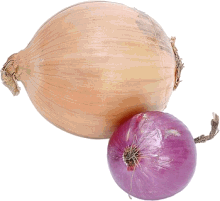
Like onions? Half of one a day can raise your HDL by 30 percent.
|
Pile on the onions: Research suggests that half of a raw onion a day may raise HDL levels by as much as 30 percent.
Drinking: One or two alcoholic drinks a day may help to increase HDL levels. An ideal choice may be red wine: "There are antioxidants contained in red wines such as cabernet sauvignon, merlot and pinot noir, that help slow down the oxidation of HDL and LDL cholesterol," says Vincent Rifici of the Robert Wood Johnson Medical School. However, go over one or two drinks and you'll do more damage than good. Some people may experience problems with lesser amounts of alcohol as well.
Don't eliminate all fat from your diet: Just like too much fat in your diet can cause problems, too little fat in your diet can lead to a deficiency of essential fatty acids. It has also been linked to significant reductions in HDL cholesterol. For best results, eat a variety of healthy fats, like monounsaturated fats, and avoid the bad ones, like trans fats.
Quit smoking: This will result in an increase in HDL levels.
Consider taking niacin: According to the National Cholesterol Education Program (NCEP), niacin (vitamin B3) is an important tool to normalize cholesterol. Several studies have found that this vitamin can increase HDL by 30 percent while lowering total cholesterol by 10 percent to 25 percent.
Get lots of omega-3: This essential fatty acid, found in fish, fish oil, flaxseed and walnuts, has been found to increase HDL cholesterol.
If you have an interest in considering niacin plus other options or if you have high cholesterol concerns, please make an appointment to discuss your health conditions and what could be best for your specific circumstances.
Sources
The World's Healthiest Foods
The Linus Pauling Institute
Medicine Net: HDL Cholesterol
About.com: Increasing the Good Cholesterol
Raise HDL (Good) Cholesterol
